Showing posts with label family law. Show all posts

Friday, 6 March 2015

Case Law: Leave to Remove - "You can't hug Skype"

Case Reference: Re R (A Child: Relocation) [2015] EWHC 456 (Fam)

The mother sought leave to remove to enable her to relocate the child to Hong Kong to take up employment there. This case made headlines (in the Daily Mail) for the observation that Skype was no panacea to a lack of physical contact. The judge observed:
"Miss D. thought that Skype could be beneficial for a child even as young as two because the child could see who they were talking to, but the mother's proposals do not take account of time lag, competing interests in a child's life, what a two year old talks about on consecutive days, etc. Also leaving aside the technology and timing issues, the disadvantages of Skype - as any user will know - are all too often the lack of clarity of image, the sound delay even if short, and, as Miss Mills colourfully notes in her closing submissions, "You can't hug Skype".
The mother's past conduct in relation to contact and what might be viewed as controlling tendencies and a lack of recognition of the importance of the father's role in the child';s upbringing were also significant factors in her leave to remove application being refused.

Where the relocating parent is proposing Skype/telephone contact with young children, this judgment is worth bringing to the court´s attention, and the Honourable Mr Justice Wood's opinion as to Skype (given his tech-savvy experience... which isn't always universal among CAFCASS and the judiciary).

This judgment shows the detailed, critical analysis of proposals and history which is essential in leave to remove cases, and in our opinion, exemplary.

The judgment is available to read via the links below:

Re R (A Child: Relocation) [2015] EWHC 456 (Fam) - Online
Re R (A Child: Relocation) [2015] EWHC 456 (Fam) - Download

Monday, 2 February 2015

Do You Know Your Family Law - Answers and References

Click on the image to take the quiz
Having seen a range of advice, from very good to not, and given the prevalence of Facebook style quizzes, we thought we'd have some fun with a 'Do You Know Your Family Law' Quiz.

Fun but with a serious side. The quiz is intended for those involved in giving advice on family law as a lay adviser. On the whole, the questions aren't difficult for those with some experience, and if you're helping parents prepare for court, you should know the majority of the answers.

Before reading the rest of the article please Take the quiz - and share it. Don't worry, your answers aren't recorded. The site only records the number of people who take the quiz, not the answers or scores. You're anonymous!

If you want to learn more, The Custody Minefield explains the court process, contains more specialist information than most, and has detailed case law libraries including the full text of judgments in the public domain. Charity staff, McKenzie Friends and parents going through the court make use of it. Please share details of it to help others become better informed and improve their prospects.

Returning to the quiz... we give the answers (both on the quiz site and here, as we want to help inform people and highlight knowledge gaps) so please do not take someone else's published quiz result as a guarantee of their expertise or knowledge. Simply, there's nothing to stop someone cheating or guessing the answers.

Analysing your result: if you scored less than 65%, accept that you are lacking basic knowledge and the advice you give, away from text books or web reference sources is suspect. Perhaps hard to hear, but you're putting yourself and those you help at risk. Time to step back and do more study, and be very sure you're only answering questions where you're 100% sure of the answers, admitting when you don't, and not taking cases where you don't have the knowledge. If you're regularly in court supporting people as a McKenzie Friend in all stages of proceedings, you should have got at least 80%, and have got all the basic questions right (see further on).

For those who support and advise people going to court, consider if someone asked you a question which is in the quiz, and you got the answer wrong. What would be the impact on their case? How might you limit their options? Is your knowledge sufficiently good, for people taking your advice, to risk their relationship with their child through reliance upon what you can tell them?

The Questions
Below we give the question, the answer, and references which inform the answers. We also include our opinion as to whether the knowledge should be considered basic knowledge for any lay adviser, or are more specialist (but should still be known if you involve yourself in that type of case, or stage of court proceedings). Specialist answers we'd normally expect someone with good knowledge to still need to look up, so a score of 90% or above is good.

The three levels of questions are:
  1. Basic Questions - 13 of these amounting to 65% of the total score - the answers should be known by anyone advising on family law, whether as a McKenzie Friend or in a charity support capacity.
  2. Advanced Questions - 4 of these amounting to 20% of the total score - BUT... the knowledge is commonly needed depending on the nature of case or stage of proceedings. If you're involved in the type of case or stage of proceedings to which they refer, you should know the answer.
  3. Specialist Questions - 3 of these amounting to 15% of the total score. You should know where to look for the answers if involved in cases with an international element. If you scored 85% or more without guessing or cheating, well done!
Question 1: "How long do child arrangements orders normally last?"
Answer: b) Until the child named in the order is 16, unless exceptional circumstances exist.
Reference: section 9(6) of the Children Act 1989 [Statute/Legislation] [Basic]

Question 2: "If I am named in a child arrangements order as someone with whom the child lives, can I take my child abroad on holiday for 45 days?"
Answer: a) Possibly, but you must have the consent of each other holder of parental responsibility for the child, or failing this, the court's consent via a specific issue order.
Reference: section 13(1)(b) and13(2) of the Children Act 1989 [Statute/Legislation] [Basic]

Question 3: "Having a residence order or child arrangements order naming me as the person with whom the child lives gives me the right to change the child's surname."
Answer: c) Possibly. You must however first obtain the consent of each other holder of parental responsibility for your child, or failing this, have sought the court's permission via a specific issue order.
Reference: section 13(1)(a) of the Children Act 1989 [Statute/Legislation] [Basic]

Question 4: "Under which of the following circumstances would you normally need to ask the court's permission to apply for contact with a child (via a child arrangements order)."
Answer: a) You are the child's biological grandparent, and saw the child every week of their life.
Reference: section 10(5) of the Children Act 1989 [Statute/Legislation] [Basic]

Question 5: "Under which of the following circumstances would a child arrangements order automatically end?"
Answer b) Once the parents have been living together for 6 months.
Reference: section 11(5) of the Children Act 1989 [Statute/Legislation] [Basic]

Question 6: "A court will only consider making an order for shared living arrangements if the child spends half of their time with each parent."
Answer: b) False
Reference: refer to the cases K (Shared Residence Order) [2008] 2 FLR 380. Care does not need to be more or less equal for a court to make an order for shared living arrangements. The case C (A Child) [2006] EWCA Civ 235 gives a good guide as to circumstances a court may consider for the granting of shared living arrangements. [Case Law] [Basic]

Question 7: "Section 91.14 orders require a named individual to seek the court's permission before applying for further specified orders. Conditions may be attached to the order which a parent must satisfy before they will be granted permission. Is this statement..."
Answer: b) False
Reference: see Stringer v Stringer [2006] EWCA Civ 1617 - While the judge may indicate what might help a litigant in having permission granted in the future, this cannot be set down as a condition for further applications. This point of law should not be confused with a court limiting the types of order to which the s91.14 restrictions may refer. Similarly, the order may be for a specified period of time, but again, this is not a 'condition'. [Case Law] [Advanced - basic if cases involve applications for a s91.14 order]

Question 8: "Which of the following items of evidence should not be included in the court bundle unless specifically directed by the court?"
Answer: e) All of the above
Reference: Practice Direction 27A section 4.1 which related to information which should be excluded from the Court Bundle [Practice Direction] [Basic]

Question 9: Shared living arrangements (called shared residence before residence orders were replaced by child arrangements orders in April 2014), cannot be made if one parent is hostile to the idea.
Answer: b) False
Reference: the judgment in A v A [2004] EWHC 142 (Fam) [Case Law] [Basic]

Question 10: You disagree with your ex-partner's choice of school. You wish the court to resolve the matter. You should apply for...
Answer: a) Specific Issue Order
Reference: section 8(1) of the Children Act 1989 [Statute/Legislation] [Basic]

Question 11: Which of the following countries is party to the 1980 Hague Convention on the Civil Aspects of International Child Abduction?
Answer: a) Russian Federation
Explanation: Russia became a member state in 2011, however is not obliged to assume costs (Article 26 of the Convention). Saudi Arabia and Liberia are not party to the Convention. Saudi Arabia and Liberia have not signed up to the 1980 Hague Convention. [HCCH - The World Organisation for Cross-Border Co-operation in Civil and Commercial Matters] [Specialist]

Question 12: Applications for non-molestation orders and/or occupation orders (injunctive orders made in relation to domestic violence) are heard under...
Answer: b) The Family Law Act 1996
Reference: see Part IV of the Family Law Act 1996. [Statute] [Advanced - basic if supporting people at risk of or accused of domestic violence]

Question 13: The letters CAP, in respect to family law, commonly refer to...
Answer: c) The Child Arrangements Programme
Reference: see Practice Direction 12b (basic knowledge) and reforms introduced by the Children and Families Act 2014 [Practice Directions/Statute] [Basic]

Question 14: You were not married to the mother but are named as the father on the birth certificate. You automatically have parental responsibility for the children if...
Answer: b) The child was born after 1st December 2003
Reference: Amendments were made to the Children Act 1989 via the Adoption and Children Act 2002, which allows for parental responsibility to be granted to unmarried fathers whose children were born on or after 1st December 2003 (when the amendment came into force) where they were named on the birth certificate. [Statute/Legislation] [Basic]

Question 15: Courts can consider someone to be a parent, even if they are not biologically related to the children and no orders have yet been made.
Answer: a) True
Reference: refer to the case G (Children) [2006] UKHL 43 which discusses parenthood being conferred by being a natural, gestational or psychological/social parent. This is unrelated to the acquisition of parental responsibility. This information is particularly important for LGBT non-biological parents (who are a partner to the biological parent), fathers who discover they are not the biological parent where they believed themselves to be a biological parent but otherwise fulfilled this rule, and may similarly support the ongoing role and involvement of unmarried step-parents in children's lives. [Case Law] [Specialist]

Question 16: When making orders in respect of children, one factor which the court should consider is their...
Answer: b) Ascertainable wishes
Reference: see section 1(3)(a) of the Children Act 1989 and clarification of as to why the difference is important in the case H (Children) [2014] EWCA Civ 733. Children's wishes can be influenced, and this is why there is, on occasion, a stark difference between what a child says (their expressed wish) and what their underlying wishes may be (which may also be influenced by attempts at alienation). Is it possible to ascertain their wishes? Are their expressed wishes reasonable? Understanding this concept (among others) is highly important when presenting arguments in support of alienated parents. [Statute/Case Law] [Advanced - basic if cases involve parental alienation]

Question 17: Which rules govern who you can and cannot discuss your details of your case with?
Answer: a) Sections 97 of the Children Act 1989 and Family Procedure Rules [2010] 12.73 and 12.75.
Reference: Sections 97 of the Children Act 1989 and Family Procedure Rules [2010] 12.73 and 12.75 cover confidentiality in respect of family law proceedings. [Statute/Legislation/Family Procedure Rules] [Basic]

Question 18: All countries in Europe have signed up to European Council Regulation (EC) No 2201/2003 (also known as the Brussels II Revised Regulations) which governs the recognition and enforcement of judgments in matrimonial matters and the matters of parental responsibility.
Answer: b) False
Reference: Denmark did not become party to this regulation. [European Council] [Specialist]

Question 19: Which form would normally be used to apply for a parental responsibility order?
Answer: b) C1 Form
Reference: The C100 form is used for orders made under section 8 of the Children Act 1989, while the C(PRA)1 form is used where parents make a formal agreement in respect of parental responsibility. The C1 form is used for applications for parental responsibility. [Court Forms] [Basic]

Question 20: If a fact finding hearing is carried out concerning allegations of domestic violence and abuse, the court should, having determined whether or not the allegations are true...
Answer: b) record its findings in writing, and serve a copy on the parties.
Reference: See Practice Direction 12J section 29. [Practice Directions] [Advanced - But basic where support is given to those facing findings of fact]

Sunday, 22 June 2014

Family Law App: Help with Crisis Situations and More

http://www.thecustodyminefield.com/flapp/crisismenu.html

In the event you missed it, we've built our Crisis Menu into our main Resolving Disputes section.

You'll find practical, step-by-step answers and approaches to the most common crisis situations, whether your children and ex-partner are missing, you're facing a psychological assessment, there is risk of domestic violence, the children are at immediate risk of harm, it's disputed you're the father, you're not seeing your child, you face false allegations or your ex-partner is threatening to take the children abroad or move some distance away.

Whether or not the parent faces these crisis situations, knowledge of what you might do in these situations can reassure and reduce stress. 

Sections on Contact Enforcement, Internal Relocation, Leave to Remove, Parental Alienation and Paternity Testing will have dedicated case law libraries in support. We should have this section of the project concluded within the next two weeks (three of these libraries are already live, and we'll be reviewing case law as we go).

http://www.thecustodyminefield.com/flapp/welfaremenu.html
New on our Resolving Disputes Menu is a dedicated Welfare and CAFCASS section, including guides on CAFCASS, Family Assistance Orders, the role of the Guardian-Ad-Litem, Parenting Information Programmes, and a new page giving suggestions when meeting CAFCASS

Click on any of the images to be taken directly to those pages or use the links.


Monday, 16 June 2014

New Section on our App

http://www.thecustodyminefield.com/flapp/FindA.html


We've added a new section to our 'Resolving Disputes' menu called 'Resources' (click on the image to open).

The first resource is a Useful Directories page, helping parents and advisers quickly find a:

Barrister;
Contact Centre;
Court
DV Perpetrator Programme
Early Years First Aid Course
Mediator
Parenting Course
Parenting Information Programme
Psychologist
Psychotherapist (or counsellor)
Solicitor

More coming. We'll make announcements as we publish.

Checking Credentials - Therapists and Counsellors

The Children and Adoption Act 2006 introduced a variety of tools related to supporting contact activity which the court could access if the child/parent contact broke down. An anomaly was that these tools solely related to supporting contact orders and not shared residence orders. Amendments to legislation in April 2014 corrected this when contact and residence orders were combined within the new child arrangements order (click for more information on Child Arrangements Orders).

One of the tools available to the court allows a judge to order that the parents and/or child attends counselling. The child may be encouraged to meet with a therapist where alienation is suspected or some other unresolved matter is at issue causing the child to feel anxious about or resistant to seeing their parent.

Where contact has broken down entirely, it is critical to get a qualified therapist with experience. If a name is proposed by a legal adviser, welfare officer or judge, you should check that the therapist is suitably qualified and experienced. Why? In 2012, a Channel 4 News investigation found that over a fifth of expert witnesses producing reports for court were not qualified at all. Do not assume that recommended experts and professionals have the required knowledge, qualifications or expertise.

In the area of contact breakdown, alienation, family therapy or conflict resolution it is only prudent to check that those recommended as expert therapists, are! 

For more complex cases, if the court orders that a psychologist assists the family, their credentials and areas of expertise can be checked via a visit to the British Psychological Society website. Via the directory below, you can search for an individual psychologist and ascertain their experience and qualifications.

http://www.bps.org.uk/bpslegacy/dcp

Counsellors and therapists may also be directed to assist the family. The British Association for Counselling and Psychotherapy holds a register for its members, which you can check to ensure the validity of someone purporting to be BACP accredited. They also, like the other professional bodies, have a code of ethics and complaint procedure should something go wrong or service delivery be poor. Importantly, they publish hearing findings, decisions and sanctions which arise from complaints. The BACP register is approved by the Professional Standards Authority for Health and Social Care.

http://www.bacpregister.org.uk/check_register/

To find a BACP approved therapist, you can also visit their 'It's Good to Talk' site where you can search by region, specialism and approach.

Counsellors and therapists may also be a member of one of the following bodies. Please note the United Kingdom Council for Psychotherapy directory search function wasn't working when we tried it last night, and the Association of Child Psychotherapists' register doesn't differentiate between trainee and full members.

http://www.psychoanalytic-council.org/find-a-therapist/searchhttp://www.ukcp.org.uk/index.php?id=65
http://www.nationalcounsellingsociety.org/counsellors/
http://www.cbtregisteruk.com/Default.aspx
http://www.cosrt.org.uk/information-for-members-of-the-public/therapist-listing/
http://www.childpsychotherapy.org.uk/about/register-of-members/
http://www.ahpp.org/result.php?navbar=1

To help resolve broken contact, expertise is required, and if a therapist is recommended by the court, in our opinion they should be an expert, a member of a professional psychotherapy association and have specific experience. We recommend that if a person is proposed as a therapist, ask which professional body they belong to, confirm their membership by using one of the above links (if they belong to another organisation, contact that organisation to confirm their membership), and check that organisation's code of ethics/conduct and criteria for membership. It's no guarantee of success outcome, but wise, nonetheless.

Warning: You must not seek to have your child seen by a counsellor, therapist, psychologist or psychiatrist as part of a strategy to include the therapist's opinions into court proceedings to support your arguments. In such circumstances, you should seek the court's permission first. See our guide to Psychological Assessments.

Monday, 2 June 2014

Family Law App - Update, and Download Packs now online

Click to open the app
Click on the image to open the Family Law App
A further update on progress on the new family law app and content.

Please bear with us as the new content goes online. This has been a huge project. Over 1,000,000 words of content, and aimed at detailed process mapping of family law making it accessible for all.

We can confirm the Dyslexia and Court pack is back among 4 free download packs (accessed via our Shop page), with another 16 covering applications and various stages / aspects of the court process.

New Content
  • All free online guides are now available. Search content via application menus or via a Full Content List.
  • Draft Court Orders have been added to our Court Forms (now Court Forms and Draft Orders) section.
  • Child Arrangements Orders download pack (is now available in our Shop including our child arrangements order and mediation guides, a checklist for applications, the necessary court forms and the court services' process flowchart and guides to applying to court and court fees.
  • C110A added in respect of Emergency Protection Orders (included in the EPO pack via the Shop and as part of the Court Forms page).
  • C7 Form also added.
  • CAFCASS's Commissioning Directory added to our Parenting Information Programme page.
  • CAFCASS's Family Assistance Order Guidance added as a download to our Family Assistance Order page.
  • Mediation guide and Form FM1 now included with all Section 8 order packs in our shop.
  • Domestic Violence Perpetrator Programme Leaflet and Questions and Answers Leaflet added to our Domestic Violence page as button links.
Content Updated/Added
  • Links to case law kindle books updated in our Shop
  • Court Forms - All forms updated.
  • Our CAFCASS pack now includes for reference, Working Together To Safeguard Children, CAFCASS's Child Protection Policy, Complaints Guidance (updated), Reporting to Court Policy and Guidance, CAFCASS's Policy Framework, their Family Assistance Order Guidance, and a blank Section 7 Report, as well as our own guide and a tips sheet for assessment meetings.
  • All 20 download packs in our Shop have been fully updated.
Bug Fixes
  • Due to a data corruption in our court forms library in early May, the old C100 form and certain others were restored by our web host in place of the new forms. This is now fixed, and required a full rebuild of the library. We took this opportunity to load additional forms for more specialist areas of family law.
  • Download packs. Some browsers don't recognise blank spaces in file names. We've renamed download files to adjust for this.
In Progress
  • Case law libraries - full content in stripped down html for fast loading - 4 libraries completed (Internal Relocation - Leave to Remove - Paternity Testing - Interim Contact case law uploaded including print and online versions of judgments). .
  • Parental Alienation - Section 91.14 - Occupation Orders - Shared Residence case law libraries in progress.
  • Family Law Dictionary - part complete.
  • Search functionality follows completion of content when a site map can be completed to power the integral search engine.
  • Children Act 1989 - to be built in our html format for reference.
  • CMEC/CSA page to be updated following recent changes.
  • A section on shared residence within child arrangement orders.
We're getting there, but it was and is a huge project. Bear with us!

Tuesday, 22 April 2014

Guide Updates and our New Family Law App

http://www.thecustodyminefield.com/flapp/menu.html
It's April 22nd, and the new Children and Families Act 2014 comes into force today.

Gone are residence and contact orders, replaced by child arrangement orders. Enforcement powers granted to the court by virtue of the Children and Adoption Act now apply not just to contact, but to child arrangements orders in general (correcting the anomaly of those measures not being applied when parents shared residence).

Has much else changed? Yes. What evidence can be included with a statement, practice directions for court bundles and when a bundle need be prepared and by whom, and the need to attend mediation has been cemented in statute (and the exemption criteria changed). The court process has changed a little, we've a new family court structure, there have been some changes to court fees.

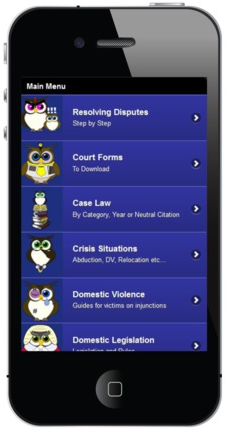
To help you cope, today we've launched our new, updated and improved Family Law App.

We're still finishing some content (but the changes to the law have been rather rushed) and over the next coming fortnight you'll see the inbuilt legal dictionary completed, a fully integrated search function go live, the revised wording for the Children Act integrated in our legislation section, revised and more detailed case law libraries, and in the next 48 hours our downloadable guide packs will be completed and uploaded. Bear with us, it's been quite a task, but we think you'll like what you see. 1,000,000 words of content... more than 100 specialist guides...  many 100s of questions answered... updated in rapid time given the new family law act only came in a month ago!

More than this, we've rebuilt our old app from the ground up. We wanted more content, improved accessibility and simplicity, and the app to be less overwhelming and frankly... 'friendlier'. We think we cracked it.

All Platforms Supported

Our Family Law App runs on all web browser, pcs, Macs, smartphones, tablets, browsers and operating systems... truly accessible... built on the renowned jquerymobile platform utilising HTML5. Touch screen or mouse friendly too [Ed: mouse friendly owls?]. One of the final sections to finish, the case law libraries, will load far faster than before, cutting your mobile phone bills if you need fingertip access to content in court (or on the bus, or in Starbucks).

Updated Content

  • Applying to Court
    http://www.thecustodyminefield.com/flapp/menu.html
  • Barristers
  • C100 Form (New Form) 
  • Contact Centres
  • Contact Orders (application aspects removed)
  • Court Fees
  • Courts and Judges
  • Domestic (UK) Child Abduction
  • Emergency (Abridged) Hearings
  • Emergency Protection Orders
  • False Allegations (in respect of new expert evidence restrictions and the ever changing landscape of drugs testing companies(.
  • Finding of Fact Hearings
  • First Dispute and Resolution Hearings
  • Internal Relocation
  • International Child Abduction
  • Leave to Remove
  • Parental Responsibility (Acquisition)
  • Parental Responsibility (and Disputes)
  • Parental Responsibility (and Education)
  • Parenting Plans 
  • Permission to Apply
  • Preparing a Statement
  • Prohibited Steps Orders
  • Residence Orders (application aspects removed)
  • Shared Residence
  • Skeleton Arguments
  • Solicitors
  • Specific Issue Orders
  • Step Parents and Parental Responsibility
New Content
  • Case Allocation and Gatekeeping
  • Child Arrangements Orders
  • Directions and Review Hearings 
  • Dispute Resolution Hearing
  • Final Welfare Hearing
  • Issue Resolution Hearings
  • Preparing Evidence
Art and Design

Our sincere thanks to Reggio Blackwell for his design work and giving us our family law owls. Reggie is  a talented US artist and art lecturer who also does graphic work for major computer gaming firms. We love them! Thanks too, to Steve Roberts, for assisting with the technical issues related to the app programming.


Emails saying 'the project must have been a hoot'... or 'owls about that' will not be replied to. However if you spot a broken link or a typo, please let us know by emailing us at admin@thecustodyminefield.com

Monday, 9 December 2013

flApp v.2 - Family Law Support for 2014

In January 2014 we launch our new Family Law App... flApp v.2

2006 saw our first venture into family law information for separating parents, and The Custody Minefield book reached no.2 on Amazon's Divorce Chart. A reviewer in the Magistrates Magazine said it would 'save parents a fortune in legal fees'. The Divisional Chair of the British Association for Counselling and Psychotherapy described it as a 'gem of information'.

The law isn't static, and print media soon becomes out-of-date. With legal aid being abolished and charity funding being cut, litigants the need for detailed support information has become even greater. I often am asked 'can you recommend a good family law book?' Not if it was written more than a year ago. The Low Commission (tasked with investigating support tools to plug the hole left by legal aid cuts) calls for action by 'the next Government'. Parents and their children need help now! Not after the next election.

In 2012, we launched our first web based application. This grew into a behemoth of information, as more and more content was added covering an ever wider array of situations and circumstances. We feared this was becoming overwhelming for the user.

When building this new version, we faced three dilemmas.

1. We wanted more content, not less. Something easily accessible, but not dumbed down. The volume of content needed thoughtful structuring,  in a more user friendly format.

2. We felt the volume of information in our first app was too overwhelming for some litigants, and especially when they are hindered by stress... but that depth of information is necessary to ensure the litigant can be properly armed, to achieve an 'equality in arms' (or as close as we could get it).

3. We were aware that a number of charities have support staff who use our guides, as do some McKenzie Friends. Specific guides would need to be quickly accessed while an adviser is on the phone, or with a parent or grandparent, face-to-face. Different users would need to access information in different ways.

In short, our goal was to provide more information, in a more accessible format, which was not overwhelming for the user, and would be of benefit to both the novice litigant and experienced adviser on family law.

This has been no easy feat. The new app answers many hundreds of questions and we estimate has 1,000,000 words of content (we stopped counting after 850,000).

Accessibility - Design
Accessibility is critical for any application. The format will need to work across all popular phones, tablet, e-reader, and desktop platforms. The design needs to cater for touch screen or keyboard usage. It does!

Accessibility - Structure
Rather than a long list of guides, we've opted for content specific, menu driven access, which breaks information into 'digestible' chunks, and where the user is lead from guide to guide.

The litigant-in-person (new to family law) chooses the first button 'Resolving Disputes', whereupon they're taken to a stage by stage, guide to the legal process.

Step 1: Pre-Litigation (guides on mediation, handling stress, helping children cope etc).
Step 2: Applying to Court (everything from orders explained, to the application process, forms etc)
Step 3: The first hearing (the FHDRA explained, position statements, the role of CAFCASS, confidentiality, courts and judges, etc)
Step 4: Directions and interim hearings (bundles, statements, collating evidence, investigations etc)
Step 5: Contested/Final hearings (preparation, bundles, scott schedules, skeleton arguments, submissions etc).

Simple guides on most other sites simply fail to cover more complex situations, and don't provide information which the litigant needs. What does a 'statement' look like? How should it be structured? What goes into a skeleton argument? What on earth is a Scott Schedule or the Witness Template? Who can I ask for advice (a question some court clerks appear confused on, when telling litigants they can't speak to lay advisers without the court's consent... you can!)?

So we go into detail... 

Taking Leave to Remove as an example (where one parent seeks to take a child to live abroad and the other parent opposes the move), our guides provide information as to what the court considers important, steps you may take, domestic as well as international legislation, and case law.

If your children are missing, you come home and the house is empty, if your children are at risk of removal abroad, suffering abuse or neglect, are being alienated from you or it's disputed whether you're their parent... you'll find practical information to assist you, referenced to the latest court judgments, and all commonly asked questions are answered.

Accessibility - Choices
If you know what you want, and would sooner not search through menus, we're introducing Oscar. Using page specific meta-tags, Oscar, our search agent, hunts for specific content.

Oscar searches through guides, menus and case law. Regarding case law searches, you can search using the area of law (e.g. contact disputes, parental alienation, leave to remove, internal relocation, shared residence etc...). If you remember the year and the judge who heard the case, Oscar can bring up cases heard by a specific judge or in a given year. If you know the neutral citation number, that's fine too (but how many of us do!). In short, Oscar is your dedicated family law librarian and can be accessed as a 'pop up' on any page with the press of a button.


For the new litigant, we've added a legal dictionary, which again can be accessed from any page, and being a 'pop up' screen, you don't have to leave the page you're on to decipher legal language (and then lose your place)!

For telephone support staff who need instant access to information, we've added a full content list, which again can be pulled up as a popup, and content accessed in this way opens up as a new window (allowing multiple windows to be open at once). 


Version 2, launching in January 2014, will have case law in both html (on screen) and a downloadable alternative (in a pdf format) should litigants want to provide the court with a skeleton argument supported by a reading list and hard copy case law. Where cited in guides as an indication of matters the court considers in specific circumstances, hyperlinks take the user straight to the judgment.


Version 3 will launch in April 2014, in anticipation of changes to the family courts. The modular design structure allows us to update content... fast ... and we'll have some new surprises for you!