We don't have a perfect family justice system. It's a system which involves people, people are flawed and sometimes make bad decisions.
Sometimes parents complain about outcomes in the court. On occasion, they forget that while in court, they're part of the system, and at times, their conduct is as much a contributory factor to a bad outcome (or the main cause). They leave court blaming the system, blaming the other parent, but rarely stop to look at their own conduct.
The same criticism can be levelled at some legal advisers, and not just McKenzie Friends. I've seen solicitors and barristers equally foolish in taking an aggressive and combative stance. To my mind and in my experience, those advisors (legally qualified or not) wreck cases and wreck lives. On a pragmatic level, they hand on a plate the opportunity to show a contrast between your (or your client's) reasonable position, and that which ends up looking like a dog chewed, saliva ridden chew toy. Their narcissistic and disordered love of the fight, the battle, the attack... panders to the worst traits and vulnerabilities of the separating parents. Rather than being a protective and moderating factor, they're petrol poured on the flames. My view is they're dangerous people who shouldn't be allowed anywhere near a court or decisions relating to children. Judges need to be far more robust in slapping these people down, banning them from the court room, and if members of a profession, reporting them for misconduct.
Leave the ego at home. You may be someone who easily becomes emotionally involved due to your own past experiences. When advising someone, the most important thing to offer is objectivity (before knowledge of case law, process and protocol). If you miss the importance of prompting, nudging and poking the client into a reasonable position, you hamstring them and you're doing them a disservice. They're the ones emotionally involved, stressed, angry, bitter, upset... all of which clouds their judgment. What hope do they have if yours is clouded too. If you only ever see bad outcomes, maybe it's time to realise the common denominator is you!
...but back to parents...
I'm often asked if there's a winning strategy in family law proceedings. There's certainly one which improves your prospects (and at times dramatically), and that's taking a reasonable, consistent, non-aggressive, child centered approach. Judges like it. It's hardly surprising. They get tired of seeing case after case involving unreasonable people. While it's undeniably advantageous from a tactical perspective to be reasonable in court, embrace it in the start of your journey into separated parenthood with your ex-partner. You'll end up with less aggravation, less stress and happier kids. Your ex-partner may not engage at first, but remain reasonable, fair and courteous and many do in time.
A simple tip. Say something nice about the other parent. It's highly unlikely the court will stop their contact. You may find that by saying John/Joanne is a good dad/mum, you not only gain a measure of respect from the judge and welfare officer, but your ex loses a small portion of their anxiety over a belief you want to take 'their' child away.
In November, I was speaking on Parental Alienation and Developments in Law at a charity AGM event. The morning speaker was Sir James Munby, The President of the Family Court, and his words need to be well heeded on the risks of attitude not just in court, but to your life with your children years after:
"You may think he is an absolute monster. You may think she is an absolute ‘blanket blank’. The risk you are running is that if you carry on like this your child suddenly one day will realise what went wrong. And when the child is old enough he may walk out. He may say a plague on both your houses. You’ve ruined my life. You’ve done what Larkin famously said, you’ve “fucked me up”. I’m off. You’re both as bad as each other.
I ask them, “do you want to spend your declining years alone, hated by your child. It may take 5 years, it may take 20 years but for god’s sake think about that.”
The reality is that sooner or later the child is going to want to seek out that monster or that bitch. The child will then discover she or he is not as bad as you made out. That will have two effects. One is that there’ll be an increased wish of the child to see the other parent. The other is that the child in that circumstance will condemn you for giving a false impression. You are running a terrible, terrible risk”."1
I get people contact me years after their case has ended, and can assure you that this is not a scenario which only exists in Munby's imagination. Three friends have their kids now living with them after having faced horrific allegations, a complete cessation in contact and parental alienation. You bet it happens!
It's not enough to simply maintain a facade of reasonableness in court. You need to carry that forward after. It will probably take effort. It may conflict with your emotions... but the plain fact is that by continuing to have hostility towards the other parent, as Munby and Larkin said "You fuck up your kids." It's bad parenting. You become part of the problem, engage with it, and make it worse.
You can't control how your ex-partner behaves, but you can change how you interract with them. This doesn't mean you roll over and accept unfairness in relation to child arrangements or finances, but you decide what matters are worth dealing with and which aren't, and you then act appropriately and reasonably. You may need to take matters to court or back to court... but do so wanting to resolve a situation rather than seeing it as the next stage in a war or an opportunity to denigrate your ex. Focus on the problem, not the person. If your anger relates to infidelity, their being lazy round the house, their not paying you enough attention and such, let it go. Move on. The court simply isn't interested in those things, and frankly, by dwelling on them you damage yourself more than anyone else.
If you struggle with the emotions, and it's understandable to do so, get
counselling. You'll have an easier and happier life if you do, likely
get a better outcome in court by being more led by reason than emotion,
and your children will be happier too.
Drop words like battle, fight, war, bitch, bastard and worse. Not only in language you use externally, but within the inner dialogue which rattles round your head. The extent of hurt, fear, anger, bitterness that you experience exists with your consent. It's a choice. It may be human to take that choice, it may be understandable, but it's still a bad choice nonetheless. It's poison.
It's something you'll need to work at. Do it!
Your Attitude - Best Counsel: Worst Enemy
The written evidence you put into court, the words you use, the allegations you raise, the proprosals you make, what you say and your body language all form part of evidence. They all form a part of helping the court decide what type of a person you are.
How you interract with those in court matters too. If you're aggressive with the other side, you motivate them. If you insult the welfare officer, you make them more biased. If you keep challenging, speaking over, or arguing with the judge, you'll irritate them. They're all people too, and regardless of being in a profession, just as prone to human emotion. THINK!
The CAFCASS Officer may have made a mistake in his or her report. It's not uncommon, but people do. If you want to challenge what they said, don't accuse them of being a liar and biased. Point out they've made a mistake and be pleasant while you do. Don't fire off a complaint letter accusing them of bias, but a reasonable letter asking for a correction. Remember you need to challenge what they've said in court if (and only if) it is a serious mistake. Then, again, do so reasonably. Put in a position statement before the next hearing, asking for a correction, and drawing the error to the court's attention. Don't immediately ask for the officer to be sacked, removed or reprimanded. Make your response proportionate and do so reasonably and objectively.
In your statement, don't refer to the mother/father as the Respondent or Applicant. They have a name... use it. Don't talk about 'MY child'... it's OUR child. Once your statement is written, re-read it. Strip out emotive and accusatory wording. Focus on facts.
Think About Your Audience
Any professional writer thinks about their audience. What do you want your audience to hear. When writing a statement, your audience is first the Judge and any welfare officer/expert involved. What message do you want to get across to them. In family law proceedings, the most important matter are the arrangements you want for your children and why these are appropriate and in the child's best welfare interests. I get an impression a fair number of litigants write their statements for their ex-partner, as a way to tell them everything they felt they couldn't say (or did repeatedly) during their relationship. The last word scenario.
I see too many statements in which the writer, frankly, spends 95% of the time pointing out why the other parent is no good. They neglect to consider that they've been in a relationship with this person for years, trusted them in child care, trusted them enough to have a child with them, but suddenly want the court to view that same person as a monster. In pragmatic terms, they risk their own arguments getting lost as to why the child should be spending time in their care in their attempts to prevent the child spending time in the other parent's. Sometimes, they fail to include their own proposed arrangements at all. Typically, they fail to see the irony in allegations which is a common occurence when false allegations are made. Stick to the truth and you won't get caught out. Exaggerate or lie and you'll risk the judge doubting everything you say.
The same with parents who demand children spend 50% of the time with them without saying at all what it is they do with the children, how they support the child, what activities they undertake together etc. They fail to mention once why their proposed arrangements are in their child's best interests (rather than their own). Little wonder that courts sometimes form a view that the parents are more interested in a tug of war rather than their child's welfare. If you believe shared parenting supports a child's best interests, you need to include the 'why' in your arguments, and not just relate it to children in general, but your own in terms of their specific need and circumstances. In this I used the term shared parenting as both being fully involved in all important aspects of their child's life and care (rather than a stict mathematical division of time to the minute).
Digging the Bottomless Hole
Digging the Bottomless Hole
Cases are wrecked by aggressive and combative strategy. Cases are wrecked by parents intent on punishment rather than resolution. The ones who scream unfairness at the system while wanting their partner jailed over a single day of lost contact and then can't understand why the court believes them controlling and upholds that non-molestation order. The one who glares at their expartner throughout proceedings. The ones who complain about bias but walk into court expecting the whole system to be weighed against them. The ones who throw insults at the people who decide their children's arrangements. The ones who slag off their ex-partner all over social media. The ones who stalk their ex-partner's 'friends lists' and then contact them to say how bad that parent is. The ones who make false allegations. The ones who are violent or who damage their ex-partner's property. The parent 'devastated' at losing a leave to remove case who has shown themselves to be nothing but hostile to contact... and the examples go on and on, but at the core, is the wrong attitude.
The system isn't perfect. There can be unfairness, but there are plenty of instances where it gets things right. Where parents are reasonable, I'd go as far as to say this is the likely outcome. As Munby said, a system based on human beings will never be perfect. You won't change the system overnight (if ever into something ideal), but you can control your part in it (and after).
 New Guide
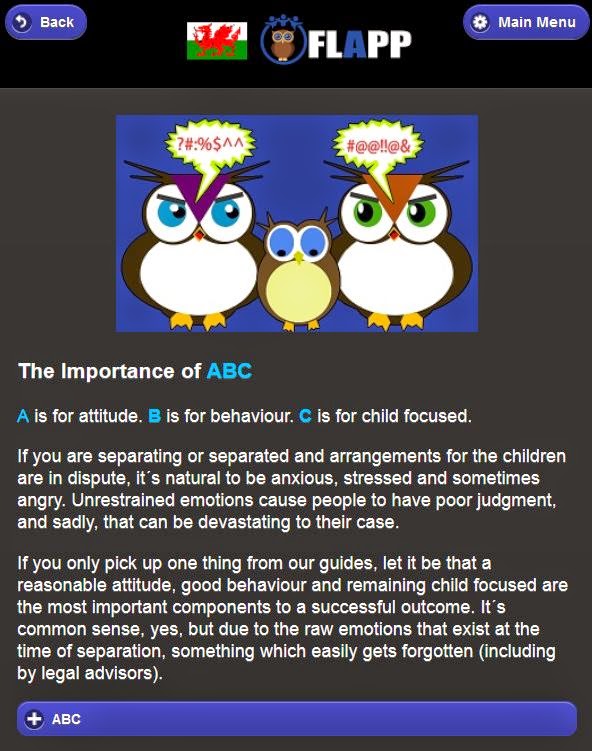
To help parents avoid some of these pitfalls, and as it's such an important component of a successful outcome in court (and after), we have a new guide built into our Family Law App addressing ABCs (Attitude, Behaviour, and being Child Focused)... click the image.
To help parents avoid some of these pitfalls, and as it's such an important component of a successful outcome in court (and after), we have a new guide built into our Family Law App addressing ABCs (Attitude, Behaviour, and being Child Focused)... click the image.
End Note
1 Sir James Munby, President of the Family Division. Keynote speech to Families Need Fathers AGM [16 November 2014]
Acknowledgments
Thanks, as ever, to Reggio Blackwell for the artwork.