Showing posts with label family court. Show all posts

Monday, 8 December 2014

How to destroy your court case

We don't have a perfect family justice system. It's a system which involves people, people are flawed and sometimes make bad decisions.

Sometimes parents complain about outcomes in the court. On occasion, they forget that while in court, they're part of the system, and at times, their conduct is as much a contributory factor to a bad outcome (or the main cause). They leave court blaming the system, blaming the other parent, but rarely stop to look at their own conduct.

The same criticism can be levelled at some legal advisers, and not just McKenzie Friends. I've seen solicitors and barristers equally foolish in taking an aggressive and combative stance. To my mind and in my experience, those advisors (legally qualified or not) wreck cases and wreck lives. On a pragmatic level, they hand on a plate the opportunity to show a contrast between your (or your client's) reasonable position, and that which ends up looking like a dog chewed, saliva ridden chew toy. Their narcissistic and disordered love of the fight, the battle, the attack... panders to the worst traits and vulnerabilities of the separating parents. Rather than being a protective and moderating factor, they're petrol poured on the flames. My view is they're dangerous people who shouldn't be allowed anywhere near a court or decisions relating to children. Judges need to be far more robust in slapping these people down, banning them from the court room, and if members of a profession, reporting them for misconduct.

Leave the ego at home. You may be someone who easily becomes emotionally involved due to your own past experiences. When advising someone, the most important thing to offer is objectivity (before knowledge of case law, process and protocol). If you miss the importance of prompting, nudging and poking the client into a reasonable position, you hamstring them and you're doing them a disservice. They're the ones emotionally involved, stressed, angry, bitter, upset... all of which clouds their judgment. What hope do they have if yours is clouded too. If you only ever see bad outcomes, maybe it's time to realise the common denominator is you!

...but back to parents...

I'm often asked if there's a winning strategy in family law proceedings. There's certainly one which improves your prospects (and at times dramatically), and that's taking a reasonable, consistent, non-aggressive, child centered approach. Judges like it. It's hardly surprising. They get tired of seeing case after case involving unreasonable people. While it's undeniably advantageous from a tactical perspective to be reasonable in court, embrace it in the start of your journey into separated parenthood with your ex-partner. You'll end up with less aggravation, less stress and happier kids. Your ex-partner may not engage at first, but remain reasonable, fair and courteous and many do in time. 

A simple tip. Say something nice about the other parent. It's highly unlikely the court will stop their contact. You may find that by saying John/Joanne is a good dad/mum, you not only gain a measure of respect from the judge and welfare officer, but your ex loses a small portion of their anxiety over a belief you want to take 'their' child away.

In November, I was speaking on Parental Alienation and Developments in Law at a charity AGM event. The morning speaker was Sir James Munby, The President of the Family Court, and his words need to be well heeded on the risks of attitude not just in court, but to your life with your children years after:
"You may think he is an absolute monster. You may think she is an absolute ‘blanket blank’. The risk you are running is that if you carry on like this your child suddenly one day will realise what went wrong. And when the child is old enough he may walk out. He may say a plague on both your houses. You’ve ruined my life. You’ve done what Larkin famously said, you’ve “fucked me up”. I’m off. You’re both as bad as each other. 
I ask them, “do you want to spend your declining years alone, hated by your child. It may take 5 years, it may take 20 years but for god’s sake think about that.”
The reality is that sooner or later the child is going to want to seek out that monster or that bitch. The child will then discover she or he is not as bad as you made out. That will have two effects. One is that there’ll be an increased wish of the child to see the other parent. The other is that the child in that circumstance will condemn you for giving a false impression. You are running a terrible, terrible risk”."1
I get people contact me years after their case has ended, and can assure you that this is not a scenario which only exists in Munby's imagination. Three friends have their kids now living with them after having faced horrific allegations, a complete cessation in contact and parental alienation. You bet it happens!

It's not enough to simply maintain a facade of reasonableness in court. You need to carry that forward after. It will probably take effort. It may conflict with your emotions... but the plain fact is that by continuing to have hostility towards the other parent, as Munby and Larkin said "You fuck up your kids." It's bad parenting. You become part of the problem, engage with it, and make it worse.

You can't control how your ex-partner behaves, but you can change how you interract with them. This doesn't mean you roll over and accept unfairness in relation to child arrangements or finances, but you decide what matters are worth dealing with and which aren't, and you then act appropriately and reasonably. You may need to take matters to court or back to court... but do so wanting to resolve a situation rather than seeing it as the next stage in a war or an opportunity to denigrate your ex. Focus on the problem, not the person. If your anger relates to infidelity, their being lazy round the house, their not paying you enough attention and such, let it go. Move on. The court simply isn't interested in those things, and frankly, by dwelling on them you damage yourself more than anyone else.

If you struggle with the emotions, and it's understandable to do so, get counselling. You'll have an easier and happier life if you do, likely get a better outcome in court by being more led by reason than emotion, and your children will be happier too.

Drop words like battle, fight, war, bitch, bastard and worse. Not only in language you use externally, but within the inner dialogue which rattles round your head. The extent of hurt, fear, anger, bitterness that you experience exists with your consent. It's a choice. It may be human to take that choice, it may be understandable, but it's still a bad choice nonetheless. It's poison.

It's something you'll need to work at. Do it!

Your Attitude - Best Counsel: Worst Enemy
The written evidence you put into court, the words you use, the allegations you raise, the proprosals you make, what you say and your body language all form part of evidence. They all form a part of helping the court decide what type of a person you are.

How you interract with those in court matters too. If you're aggressive with the other side, you motivate them. If you insult the welfare officer, you make them more biased. If you keep challenging, speaking over, or arguing with the judge, you'll irritate them. They're all people too, and regardless of being in a profession, just as prone to human emotion. THINK!

The CAFCASS Officer may have made a mistake in his or her report. It's not uncommon, but people do. If you want to challenge what they said, don't accuse them of being a liar and biased. Point out they've made a mistake and be pleasant while you do. Don't fire off a complaint letter accusing them of bias, but a reasonable letter asking for a correction. Remember you need to challenge what they've said in court if (and only if) it is a serious mistake. Then, again, do so reasonably. Put in a position statement before the next hearing, asking for a correction, and drawing the error to the court's attention. Don't immediately ask for the officer to be sacked, removed or reprimanded. Make your response proportionate and do so reasonably and objectively.

In your statement, don't refer to the mother/father as the Respondent or Applicant. They have a name... use it. Don't talk about 'MY child'... it's OUR child. Once your statement is written, re-read it. Strip out emotive and accusatory wording. Focus on facts.

Think About Your Audience
Any professional writer thinks about their audience. What do you want your audience to hear. When writing a statement, your audience is first the Judge and any welfare officer/expert involved. What message do you want to get across to them. In family law proceedings, the most important matter are the arrangements you want for your children and why these are appropriate and in the child's best welfare interests. I get an impression a fair number of litigants write their statements for their ex-partner, as a way to tell them everything they felt they couldn't say (or did repeatedly) during their relationship. The last word scenario.

I see too many statements in which the writer, frankly, spends 95% of the time pointing out why the other parent is no good. They neglect to consider that they've been in a relationship with this person for years, trusted them in child care, trusted them enough to have a child with them, but suddenly want the court to view that same person as a monster. In pragmatic terms, they risk their own arguments getting lost as to why the child should be spending time in their care in their attempts to prevent the child spending time in the other parent's. Sometimes, they fail to include their own proposed arrangements at all. Typically, they fail to see the irony in allegations which is a common occurence when false allegations are made. Stick to the truth and you won't get caught out. Exaggerate or lie and you'll risk the judge doubting everything you say.

The same with parents who demand children spend 50% of the time with them without saying at all what it is they do with the children, how they support the child, what activities they undertake together etc. They fail to mention once why their proposed arrangements are in their child's best interests (rather than their own). Little wonder that courts sometimes form a view that the parents are more interested in a tug of war rather than their child's welfare. If you believe shared parenting supports a child's best interests, you need to include the 'why' in your arguments, and not just relate it to children in general, but your own in terms of their specific need and circumstances. In this I used the term shared parenting as both being fully involved in all important aspects of their child's life and care (rather than a stict mathematical division of time to the minute).

Digging the Bottomless Hole
Cases are wrecked by aggressive and combative strategy. Cases are wrecked by parents intent on punishment rather than resolution. The ones who scream unfairness at the system while wanting their partner jailed over a single day of lost contact and then can't understand why the court believes them controlling and upholds that non-molestation order. The one who glares at their expartner throughout proceedings. The ones who complain about bias but walk into court expecting the whole system to be weighed against them. The ones who throw insults at the people who decide their children's arrangements. The ones who slag off their ex-partner all over social media. The ones who stalk their ex-partner's 'friends lists' and then contact them to say how bad that parent is. The ones who make false allegations. The ones who are violent or who damage their ex-partner's property. The parent 'devastated' at losing a leave to remove case who has shown themselves to be nothing but hostile to contact... and the examples go on and on, but at the core, is the wrong attitude.

The system isn't perfect. There can be unfairness, but there are plenty of instances where it gets things right. Where parents are reasonable, I'd go as far as to say this is the likely outcome. As Munby said, a system based on human beings will never be perfect. You won't change the system overnight (if ever into something ideal), but you can control your part in it (and after).
http://www.thecustodyminefield.com/flapp/abc.html
New Guide
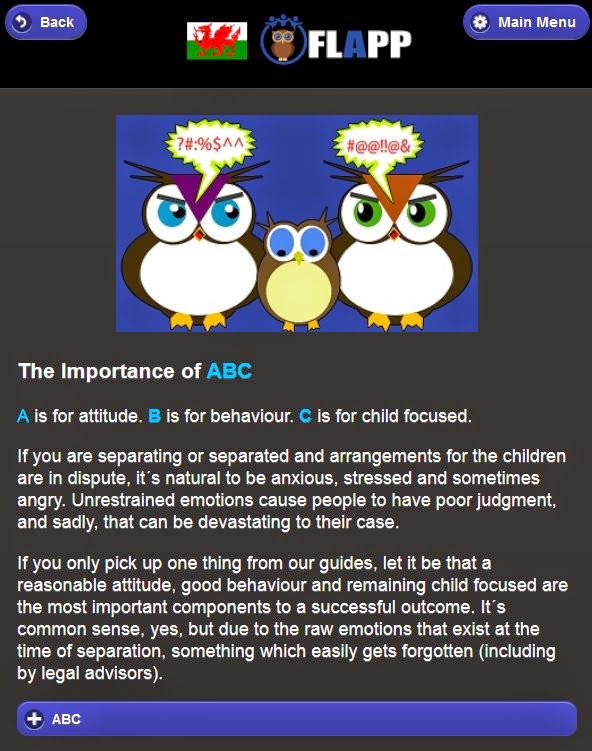
To help parents avoid some of these pitfalls, and as it's such an important component of a successful outcome in court (and after), we have a new guide built into our Family Law App addressing ABCs (Attitude, Behaviour, and being Child Focused)... click the image.

End Note

1 Sir James Munby, President of the Family Division. Keynote speech to Families Need Fathers AGM [16 November 2014]

Acknowledgments

Thanks, as ever, to Reggio Blackwell for the artwork.

Monday, 9 June 2014

The Family Law Nightmare for Dyslexic Parents

A recent blog by Lucy Reed of Pink Tape  highlighted that, even for the legal profession, the length and complexity of court paperwork can be a frustration.1

Imagine how difficult things become for a parent with dyslexia, when faced with a 24 page application form or being presented with a 350 page court bundle.

We've helped a fair number of parents with dyslexia. Common problems include form filling and reading documentation related to proceedings (statements, CAFCASS reports, directions, orders, skeleton arguments, case law and the list goes on...). Also, communication difficulties which become exacerbated when the parent is placed under stress, and let's be honest, you can't get much more stressful than a court appearance when your relationship with your child is in the balance. 

One father we knew had this habit of saying 'do you understand what I mean' whenever he attempted to explain things and became stressed. For him, his disability affected recollection of the sequence of events, and long, oral questions confused him, so he'd ask the barrister to repeat them. The court interpreted this as his being disingenuous, and sadly, he was ridiculed for his 'odd manner of answering questions'. The assumption was that dyslexia only affects how someone digests written information. The assumption was wrong, and the odd response was the surfacing of a coping mechanism mixed with embarrassment and confusion.

Problems are compounded by the court and professionals involved assuming the parent will have no difficulties if they hold qualifications and responsible jobs (as that father did). Another court downplayed the young father's disability because he had a degree. The father didn't articulate that throughout his degree course, documentation was provided in a specialised format, he had text to speech software he could use, and a rather clever "reading pen" which scanned text and converted it to the spoken word. He struggled with underlined text, handwritten text or italics, or documents printed on plain white paper. All of his study materials had been printed on blue, matt paper. 


In our experience, the parent sometimes dismisses their disability without realising the extent of how stress will affect them during proceedings. How could they know? Court and the court experience is beyond many people's experience. Coping strategies and tools used in day-to-day life or for education may not be available during proceedings (such as those used by the father in the above example). At the time such things are needed, the comment 'you should have asked earlier' is counter-intuitive as the litigant is unaware of how they will react to the unnatural stresses of court until there.

Speaking to these parents, we've learned what helps and what hinders. We've also had input from a psychologist friend who has profound dyslexia. Sadly, we can't trim down court forms, or help everyone. We can, and have, compiled a suggested list of reasonable adjustments which the litigant-in-person or represented parent's solicitor can append to the C100 (or other) court form, which reminds the court of their obligations, and includes a list of adjustments which may help parents with specific learning difficulties, and help the court to ensure it meets its Equality Act responsibilities.

Again, asking someone without experience of court what reasonable adjustments will help them can sometimes produce confusion, whereas providing a list of possible adjustments is a practical starting point.

In addition, our guide to dyslexia and the court can be read as part of our standard 'app' or comes as part of a download pack (together with our suggested reasonable adjustments list). We've now made sure that the links to these guides are prominently displayed on our Resolving Disputes Menu.


Click to open
In our guides (whether onscreen or download versions), we've sought to use dyslexia friendly fonts, avoid underlining and italic script, and also chosen a platform for our family law app which is compatible with text to voice software (the platform used adheres to the WAI-ARIA web accessibility initiative). Our white on black/blue text was deliberately chosen after testing various style sheets on associates with dyslexia to find which was easiest to read (our thanks for their patience and feedback).

Sadly, internet software's love of underlining hyperlinks continues to be a frustration for us and we're moving away from hyperlink text to link buttons to make content even more accessible.


To those in the legal profession, whether qualified or lay advisers, 10% of your clients will be affected by dyslexia. We all need to be active in asking whether clients have dyslexia, whether they use any tools to assist them in their day-to-day life (or historically during study), and how stress affects their coping strategies. We recommend taking them through our 'Reasonable Adjustments' document, and make use of it to identify reasonable adjustments which will help reduce the risk of their disability causing them disadvantage in court. The risks are too great to ignore how dyslexia might affect them, and at a contested hearing, it may be too late to suddenly raise that there's a problem (albeit in an ideal world, there shouldn't be!).

Please familiarise yourself with our guide, which references documents which set out the court's responsibilities under the Equality Act 2010. Don't be 'fobbed off' on costs grounds or because making adjustments is inconvenient. Educate those around you so they are aware that even the brilliant, qualified and successful may struggle to read a simple, hand written document or answer a lengthy question under cross-examination. If you think our guides can be made more accessible... please let us know!

Our Dyslexia and Court Pack and Guide are free.

http://www.thecustodyminefield.com/flapp/dyslexia.html
http://www.thecustodyminefield.com/flapp/freepack/dyslexia.html

1. A Jarnyced View. http://www.pinktape.co.uk/rants/a-jarndyced-view/. Pink Tape [29 May 2014]

Friday, 3 January 2014

Time: Family Law Reform, Advocacy, and Child Welfare

Time is critical in a child's life, and in resolving parental disputes. Long court cases and uncertainty cause stress, depression and other illnesses which can impact on both parents and children (not to mention work and finances, the wider family and the public purse).

The timely resolution of parental disputes was one of the key principles upon which the Children Act was based. yet almost a quarter of a century later, court cases simply take too long.

A Case in Point
Why am I blogging about this today? Another case where a raft of contradictory allegations are unexpectedly dropped into a case at the last minute, alluding to child abuse over years which was never mentioned in earlier proceedings or applications. Given the nature of the allegations, contact is stopped until the allegations can be investigated. CAFCASS have announced they are unable to report for three months. Thoughts of supervised contact are delayed until statements are submitted and future hearings listed, which delays things by at least another month. Supervised contact might be agreed at the next hearing (dependent on the cramped judicial timetable, availability, and in the absence of the CAFCASS report), and then booked, carried out, and reported on... all of which creates further delay. The hoped-for judicial continuity hasn't happened. The Circus has come to town again!

As often happens, there is no independent evidence of abuse. Without going into details, all evidence actually suggests a very happy child, with no behavioural or emotional issues, and allegations are based upon the word of the party who could have raised these allegations on numerous occasions in the past, but didn't. The accuser places themselves in the somewhat surprising position of having sent their child to contact for a long period of time despite 'seemingly' believing abuse was taking place. Forgive me for being a little suspicious... I have little doubt it will be found that there are no welfare concerns when investigations are concluded, but also that there will be no sanctions for false allegations having been made.

...so back to the Children Act 1989, at section 1(2):

In any proceedings in which any question with respect to the upbringing of a child arises, the court shall have regard to the general principle that any delay in determining the question is likely to prejudice the welfare of the child.

How is it that a three month delay, before CAFCASS can report, is acceptable? Why can't CAFCASS report within 7 days. Their resources won't permit it, I know... but the same amount of reporting will still be done by them, the same amount of time spent on meeting parents and writing reports. The delay is caused by their backlog of cases, which needs resolving, and means no officer can be allocated for weeks. 

The problem is we don't expect cases to be resolved quickly. We become used to delays, and it becomes acceptable that the child's welfare will suffer. That's the reality of this case and for this child and many others. The delays are accepted with shrugged shoulders. It's acceptable for child welfare to suffer. 

Broken contact and false allegations, perhaps being two of the most vicious forms of emotional/psychological abuse, aren't treated as domestic violence. Again, a shrug of the shoulders, and a view (with experience) that such things are common in family law cases.

Arguably, our acceptance, the court's acceptance, CAFCASS's acceptance invites the problem to continue, unaddressed.

While understanding allegations need investigating, and that at times the court needs to take a cautious approach, the harm caused to children from a sudden change to the status quo (the cessation of contact) would be mitigated by better case and resource management. Unnecessary delays cause children unnecessary harm. The delays cause harm to both parents (even those who raise false allegations). Also, long cases are arguably more expensive for the public purse, courts and welfare services... but we're used to this situation... shrug.

CAFCASS have previously been censored by the President of the Family Court when cases averaged 40 weeks until a report was prepared. The President should not need to give the CEO of CAFCASS another rollicking. The DfE should be better managing, targeting and improving performance and resourcing.

In the past quarter of a century, we've become used to these failings. Maybe it's time everyone stopped shrugging their shoulders and applied the paramountcy principle to this area too!

The Early, Inquisitorial Approach
In 2012, Mr Justice Ryder (now Lord Justice Ryder) announced that as part of judicial modernisation, the judiciary would take a more inquisitorial approach (see the Fourth Update). I've seen a number of cases in 2013 which were resolved at the first hearing and dispute resolution appointment. I've seen near identical cases take 18 months to resolve. Why the difference?

In the cases resolved without delay, both parties were litigants-in-person, and the judiciary took that recommended inquisitorial approach, questioning both the alleged and the accuser at the first hearing. Cases involved cessation of contact and allegations, but the courts took a firm approach and gave adequate time for both parties to be heard at that first hearing. This wouldn't be achieved in a 15 minute or half hour timetable which is commonplace elsewhere. 

The opinion that litigants-in-person delay proceedings isn't always true. What delays proceedings (aside from poor case management) is insufficient time being allocated to hear evidence at early hearings. Such time, if allocated, needn't place an additional burden on the court, but can and does reduce overall court time when more cases can be resolved on the day by negating the need for further directions hearings and a drawn-out contested/final hearing. 

The courts are using a more inquisitorial approach when parties are litigants-in-person. Arguably, this presents the court with an opportunity for speedier resolution of cases, since the judge will hear oral evidence from the parties from the outset. Where litigants are represented, such an occurrence may not happen until a final/contested hearing (months into proceedings). In early hearings, the advocate acts as a barrier to hearing evidence directly from the client. Hearing and observing the parties is an important part of evidence... so why delay it?

I've little doubt that many litigants wind themselves up as delays cause them to become more stressed. They 'up the stakes', and at times allegations related to historic matters breed, and appear out of thin air during the long pauses in proceedings. 

When the court hears oral evidence at the first instance, directly from the parties, it then has a greater opportunity to make a final order without further delay. This is where the inquisitorial approach can have marked advantages over the adversarial system which remains commonplace in private family law. 

Among the judiciary, there is interest in change. Sir James Munby has now taken over the reins for judicial modernisation following Ryder's appointment as a Lord Justice. The role of the judge as the referee while litigants and their counsel slug it out has been questioned by Lord Judge himself:

'The traditional model of the judge as a passive arbiter, holding the ring between the protagonists, allowing the parties to adduce whatever evidence they wish and however relevant it may be to the ultimate outcome of the case or not, will change.'

We hope that the inquisitorial approach will be consistently applied regardless of whether the parties are represented, and where one or both parties are represented, from the moment the parties first walk into court. This is not a radical idea... it merely takes the preferred approach in public law for a fully inquisitorial system rather than that which exists in private family law... the adversarial fact finding environment... and rolls it out to apply regardless of whether parties are represented. Within that, we would hope for less cross-examination of parties by advocates (at a final hearing), and more instances (ideally universally) where the judge questions the litigants directly (from the outset).

Just imagine an alternative system (which isn't so different from that we're starting to see)...

Statements with evidence are required when the C100 and C7 forms are filed (which should strip at least a month out of court proceedings regardless of whether matters are resolved at the FHDRA). Documents to include a warning that future allegations relating to historic matters will not be accepted unless included within the parents' first statements.

The first hearing and dispute resolution appointment to be held within 21 days of the application being made (and 7 days granted for the respondent's statement), to provide the court with 14 days to assess the evidence on paper.

Litigants to be provided with a paper-based statement template (with a link address where one can be downloaded as an MSWord document). Simple headings included such as:
  • Brief History
  • Child's Circumstances
  • Concerns
  • Requests to the Court
From a pre-hearing reading of those statements, a judge allocates sufficient time for the first hearing and dispute resolution appointment.  If CAFCASS involvement is needed, an officer is requested and appointed to the case, to be present at that first hearing. Counsel may accompany their clients and make submissions, but the clients will be directly questioned by the judge at that first hearing, and the responses of the litigants form part of evidence. If a welfare report is required, this should be conducted within four weeks of the FHDRA, and if there needs to be supervised contact to form part of investigations, this to be started within 7 days of the FHDRA.

Radical? I would have thought more radical would be the system we have, where unacceptable delays are commonplace, child welfare is harmed by delay, and unnecessarily drawn-out proceedings put strains on the public purse.

Sunday, 6 October 2013

Mediation... Addressing the Failure

My thanks to Marilyn Stowe for her recent blog highlighting a Guardian article. That article raises the concern that the number of couples attending mediation has fallen by 47% since legal aid was abolished.

Marilyn's view was that with fewer solicitors involved in legal cases, as few parents now qualify for legal aid, litigants-in-person are unaware of the need to attempt mediation (unless one of the exemption criteria are met - details of which are included in the 'pre-action protocol' and within our guide on mediation) prior to attending court .

When working out why fewer couple are attempting mediation, it's worth looking at the experience of a parent, applying to court in person. The C100 application form used for most family court proceedings (residence, contact, specific issue and prohibited steps orders) contains no information about mediation. It does not mention that couples should attempt mediation before applying to court (unless one of the 15 exemption criteria are met). Its only reference to mediation is asking the applicant if an FM1 form is included (with no description as to what an FM1 form is!)

In short, the likely reason for parents not attempting mediation is a failure by the courts to notify them of the need. I suspect that the main culprit for the drop in numbers is chaos in the family proceedings courts caused by court closures and mergers (under-resourcing, overload), combined with magistrates not being aware of Practice Direction 3A (the Pre-Action Protocol for Mediation Information and Assessment, which supplements Part 3 of the Family Procedure Rules 2010) and the requirements regarding mediation. Does anyone in the court check if an FM1 has been provided, or ask why not? Do the magistrates tell the parents to attempt mediation first? Has the court clerk advised the magistrates that mediation should be attempted first? Given the cut backs imposed on the courts, it's hard to attribute blame to the beleaguered staff, and perhaps responsibility should rest with the Ministry of Justice for poor planning. It seems that the process has gaping holes.

We had hoped (somewhat naively) that the Low Commission review into the impact of legal aid cuts might come up with some solutions to help parents, but were disappointed to see so many of their recommendations starting 'the next Government should...'. The horse has bolted, and the recommendation is that the next farmer who owns the land should close the stable door. We need to wait for another election, a new Government, committee meetings and more debate and consultation despite there being an immediate need, and one which we've known was coming for years. The failure, again, must rest with the Ministry of Justice.

Online legal resources, despite having received considerable state funding, scratch their virtual heads in confusion when asked simple things like 'what is a statement'... and point the parent to matters relating to schools and children with special needs.  Try for yourself... ask Lisa (and then ask yourself if this resource meets the needs of the litigant-in-person who attempts to navigate the courts, lacking a solicitor to guide them).

We received no state funding. We've had no help. We've tackled the problem but the MoJ does nothing to advertise the in-depth resource we provide. Because our main online app(lication) is free (to ensure information is available to the unemployed, low paid and disabled) and self funded, we lack an advertising budget. We have approached the MoJ for funding but had no reply. Despite this, more people download the C100 court form from our site than from Her Majesty's Court and Tribunal Service (HMCTS) website. We had approaching half a million hits last year BUT, many still do not know of our existence.

We suspect that our site doesn't meet the Government's objective to have fewer parents in court (despite ours giving the strongest recommendation for mediation) to cut costs. We perhaps offer too much legal information, making the courts more accessible, which defeats the Government's objective. However, a more informed, more prepared, and better organised litigant often cuts court time! Regardless, the reason why too few parents attempt mediation must be that the courts fail to implement Practice Direction 3A.

Other legal information resources for parents either fail to notify parents of the need for mediation, or use language which suggests mediation is a nice idea rather than a requirement. The Coram's Legal Centre uses the following language 'Most parents who apply to court for a Contact Order try mediation first. The courts generally like to see that the parents have attempted to resolve the problems themselves. In many instances, legal aid will only be granted where mediation has been tried.' The language is out-of-date, and does not set out the requirement criteria set out in the pre-action protocol (ours does!).

Parents too often fail to get detailed and accurate information which satisfies the complexities of their case. I came across one recently (experiencing some horror) which involved risk of international child abduction. The parent had been told by a solicitor (wrongly) that mediation must be attempted before he applied to` court for a prohibited steps order due to flight risk. Mediation is NOT required when the application is urgent (the 10th exemption in the pre-action protocol). In a situation where there is risk of flight abroad, it is appropriate (and wise) to apply for an ex-parte prohibited steps order. To do otherwise... to advise a course of action which tips off the parent who represents a real flight risk via an invitation to mediation... was, in my opinion, negligent. 

Advice deserts are bad. The wrong advice can be fatal.

We provide guides on prohibited steps orders, and making applications in urgent situations, including where there is risk of international child abduction. Also information on defending against a leave to remove application (where the parent who wishes to emigrate seeks the court's permission to relocate abroad with the children). We don't give the parent a list of mind boggling forms to complete and send them off to the HMCTS site (to try to find the well hidden court forms). We link directly.

If HMCTS referred parents to our site, and asked courts to do the same, there wouldn't be these problems, but instead they refer parents to the Citizen's Advice Bureau (whose staff are overloaded or lacking in training in some of the complexities of court proceedings).

The statistic often bandied about is that only 10% of separating parents access the courts, suggesting this is a good thing. We don't believe so. Between 25% and 60% of children (depending on the source of the statistics) lose contact with their non-resident parent after two years of parental separation. The low number of parents who access the court may be a success for the Government's budget, but it is an abject failure for child welfare.

The immediate solution
  • CAB staff should use our online resources to assist them. Other charity staff do. Endorsements can be viewed on Linkedin; which include the President for the International Federation for Parenting Education, various CEOs of charities, barristers, social workers, mediators etc.

  • The Family Proceedings Court should ensure that every applicant to court is pointed to our Family Law App, and in particular, our guide on mediation;

  • If the Government wanted parents to attempt mediation before court (subject to exemption criteria), the clerk of the court should ensure that in every case, magistrates are informed of the requirements set out in Practice Direction 3A (paying particular attention to sub-paragraph 4.1). It should be checked whether FM1 accompanied the application form. If no FM1 form was received, at the First Hearing and Dispute Resolution Appointment (FHDRA), the circumstances should be considered, and if no exemption criteria is met, the parents should be referred back to mediation before court proceedings continue;

  • At County Court level, the Court Administration department should check if an FM1 form was included. If not, a follow up form should be sent out to the applicant asking why there was an omission. Depending on the reply, the court then has the option of referring the matter to mediation before the FHDRA (which would reduce court time);

  •  The C100 form should be redesigned to include a section explaining the requirement for mediation, and setting out the exemption criteria. The applicant should have a box to tick, if circumstances make the case inappropriate for mediation. If this is found not to be so, the court has the option of awarding costs against the applicant, if the applicant unreasonably failed to attempt mediation before applying to court. If the respondent is unwilling to attend, then this should be recorded on the FM1 form.
